


Service overview :
Wondering how long it takes to build an eCommerce website? Get a real phase-by-phase timeline — from planning to launch — with honest estimates for every build type.
So you've decided to take your business online — congratulations. Now comes the question that every entrepreneur, startup founder, and business owner eventually asks: "How long is this actually going to take?"
Search that question, and you'll find answers all over the map. Some say weeks. Others say a year. And frustratingly, they're both telling the truth.
Here's the thing — asking "how long does it take to build an eCommerce website" without any context is like asking "how long does it take to cook a meal?" Are we talking instant noodles or a five-course restaurant dinner? The answer changes completely depending on what you're making.
A lean online store with a handful of products looks nothing like a feature-rich marketplace managing thousands of listings, multiple payment options, and complex logistics. These are entirely different projects — and they deserve entirely different timelines.
So instead of giving you a number pulled out of thin air, let's walk through this properly.
First, the Big Picture
Before anything else, here's a straightforward reference point to anchor the conversation:
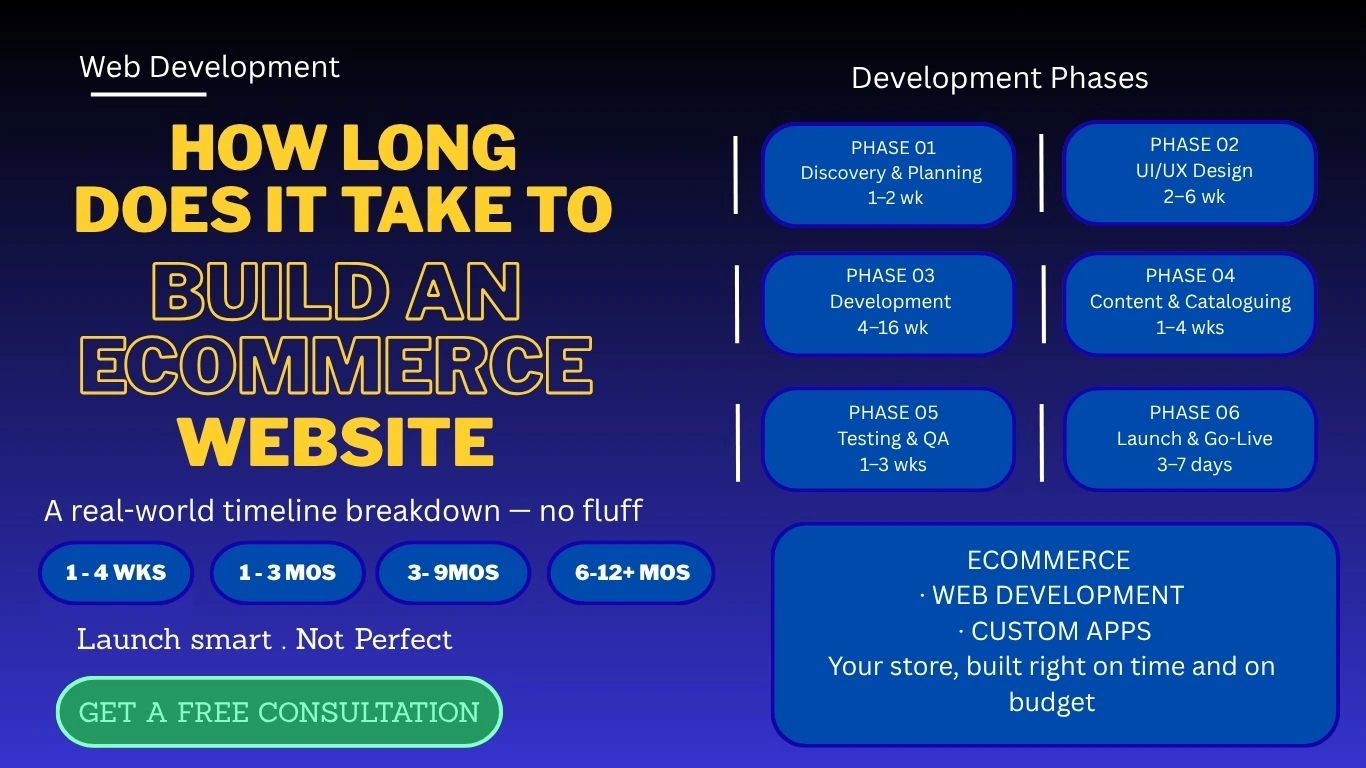
Store TypeRealistic TimelineSimple store (template-based)1 – 4 weeksSmall to medium custom store1 – 3 monthsMid-sized custom eCommerce site3 – 6 monthsEnterprise / large-scale platform6 – 12+ months
These aren't rough guesses — they're based on how real projects actually move through each phase of development. And understanding those phases is what separates business owners who plan well from those who end up frustrated by "unexpected" delays.
Let's dig in.
Every Phase of Building an eCommerce Website (And How Long Each Takes)
Phase 1: Discovery & Planning — 1 to 2 Weeks
Think of this as your project's blueprint stage. Nothing gets built without it — and businesses that skip or rush this phase almost always pay for it later in rework, confusion, and blown budgets.
During discovery, your development team sits down with you (virtually or in person) to map out everything clearly:
- What are you selling, and how large is your product catalogue?
- Who's your target customer, and how do they prefer to shop?
- Which features are non-negotiable for launch? (search filters, wishlists, multi-currency support, etc.)
- Which platform fits your business model and budget?
- What does your launch deadline look like, and where do you want this business in two years?
The clearer your answers, the smoother the entire project runs. A well-defined scope at the start can shave weeks off your overall timeline.
Estimated time: 1 to 2 weeks for small-to-medium builds; 3 to 4 weeks for large or enterprise-level projects.
Phase 2: UI/UX Design — 2 to 6 Weeks
Once the plan is locked in, your designers get to work — and this phase is about a lot more than making things look attractive. Good eCommerce design is strategic. It guides your visitors from landing page to checkout with as little friction as possible.
Here's how it typically unfolds:
Wireframes (1 – 2 weeks): Think of these as the skeleton of your website — rough, structural layouts that map out where everything lives. No colours, no fancy fonts. Just logic and flow.
Visual Design & Mockups (2 – 4 weeks): Now the brand comes alive. Typography, colour palette, imagery style, product page layouts, and the all-important checkout experience all get designed here.
Responsive Design (runs alongside the above): Your store needs to look and work flawlessly on mobile, tablet, and desktop. This isn't optional in 2025 — it's the baseline.
If your brand identity is already well-defined and your feedback is prompt and decisive, this phase moves quickly. If you're still figuring out your visual direction or need multiple rounds of revisions, plan for more time.
Estimated time: 2 to 6 weeks, depending on how much design work is involved and how efficient your approval process is.
Phase 3: Development & Integration — 4 to 16 Weeks
This is the engine room of your project. The design gets handed off, and now developers build the actual functionality that makes your store run.
There are three streams happening here, often simultaneously:
Backend Development (8 – 12 weeks for complex builds):
This is everything your customer never sees but absolutely relies on — the server-side systems that process orders, manage data, and keep transactions secure.
Database architecture and configuration
Payment gateway setup (Razorpay, Stripe, PayPal, and others)
Order and inventory management systems
User accounts, login, and authentication
Frontend Development (runs in parallel):
This is what your customers actually see and interact with.
Turning design files into working, clickable web pages
Product listing pages, product detail pages, and category navigation
Shopping cart, checkout process, and order confirmation
Search functionality and product filters
Third-Party Integrations:
Most modern eCommerce stores don't operate in isolation — they connect with other tools and platforms.
CRM systems for customer relationship management
Email marketing platforms (Mailchimp, Klaviyo, etc.)
Analytics and conversion tracking
Shipping APIs and logistics partners
Every integration you add introduces another layer of testing and potential troubleshooting. This is where project timelines can stretch if integrations aren't accounted for from the beginning.
Estimated time: 4 weeks for straightforward Shopify or WooCommerce builds; up to 16 weeks for fully custom-coded platforms.
Phase 4: Content Upload & Product Cataloguing — 1 to 4 Weeks
Here's the phase that catches most clients completely off guard.
The website can be designed and developed beautifully — but if the products aren't uploaded, it can't go live. And uploading products properly takes more effort than people expect.
Twenty products with polished images and pre-written descriptions? That's a quick job. Five hundred products, each requiring professional photography, SEO-optimised titles, detailed descriptions, correct categories, size variants, and stock counts? That's a significant chunk of time.
The smartest thing you can do: Start building your product contentlibrary before development wraps up. Get your images edited, your descriptions written, and your categories planned out early. Doing this in parallel with development can save you anywhere from 2 to 4 weeks on your overall timeline.
Phase 5: Testing & Quality Assurance — 1 to 3 Weeks
Your store is built. Your products are uploaded. Now it gets stress-tested before a single customer sees it.
A proper QA process is thorough and non-negotiable:
Testing across multiple browsers (Chrome, Safari, Firefox, Edge) and devices (iOS, Android, desktop)
End-to-end checkout flow testing — from adding a product to the cart through to payment confirmation
Live and dummy payment gateway transactions to verify everything processes correctly
Load testing to simulate high-traffic events like a product launch or sale
Security scanning to identify and patch vulnerabilities
Checking for broken links, missing images, and form errors
Launching without thorough testing is a gamble that rarely pays off. A checkout that breaks under pressure, a payment page that doesn't load on mobile, or a security gap — any of these can damage your reputation before you've even had a chance to build it.
Estimated time: 1 to 3 weeks based on feature complexity.
Phase 6: Launch & Go-Live — Up to 1 Week
The home stretch. This stage involves pointing your domain to the new website, configuring hosting, activating your SSL certificate, running final performance checks, and flipping the switch.
A development partner worth their salt won't just hand over the keys and walk away. They'll ensure monitoring tools are in place so you can track uptime, performance, and early user behaviour from the moment you go live.
Estimated time: 3 to 7 days for a well-coordinated launch.
So Why Do Projects Take Longer Than Expected?
Even with the best planning, delays happen. Knowing the common culprits puts you ahead of the curve.
Content not being ready on time is the single biggest delay across almost every eCommerce project. When development is done but product images are still being shot, or legal pages are still being written, the launch sits and waits.
Scope creep is a close second. Mid-project additions — a loyalty programme here, a subscription model there, "could we also add multi-language?" — each seem small in isolation. Together, they extend timelines significantly. Define what's essential for launch and stick to it. Extras can come in version two.
Slow internal approvals create bottlenecks that compound over time. If a design needs sign-off and it takes two weeks to get a response, the knock-on effect pushes everything back. Clear internal workflows and fast turnarounds keep momentum going.
Integration complexity is often underestimated. Connecting to a legacy ERP or a region-specific payment gateway is rarely plug-and-play. These integrations need to be identified, scoped, and budgeted for from the start.
Platform mismatch also plays a role. Choosing an overly complex platform for a simple use case, or a limited platform for an ambitious one, creates friction throughout the build. The right platform for your needs matters more than the most popular or the most powerful option.
Platform vs. Custom Development: A Honest Comparison
ApproachBest Suited ForTypical TimelineShopify / WooCommerce (template)New businesses, MVP launches1 – 4 weeksShopify / WooCommerce (custom theme)Growing brands needing unique design1 – 3 monthsMagento / BigCommerceEstablished businesses with complex needs3 – 9 monthsFully Custom DevelopmentEnterprises, unique workflows, large scale6 – 12+ months
For businesses that are just getting started, a well-set-up Shopify store is often the smartest, most cost-effective move. It gets you live quickly, lets you learn from real customers, and gives you room to grow. Migration to a more sophisticated platform is always an option once you know what your business actually needs.
For businesses with specific operational workflows, large catalogues, and long-term scalability requirements, a custom-built platform offers the kind of flexibility that off-the-shelf solutions simply can't match.
How to Move Faster — Without Sacrificing Quality
Want to trim time off your project without cutting corners? Here's what actually works:
Bring your content to the table early. Product descriptions, images, categories, legal pages — have all of this prepared before development even starts. It's one of the most impactful things you can do.
Launch lean. You don't need every feature on day one. Build and launch with your core essentials — product pages, cart, checkout, payments — and layer in additional features after you're live and generating revenue.
Give sharp, specific feedback. Vague responses during design reviews stall progress. Instead of "this doesn't feel right," say "the header feels too cluttered — can we reduce the navigation items to five?" That kind of feedback gets acted on immediately.
Partner with a team that's done this before. An experienced development agency has already navigated the pitfalls, learned which integrations cause trouble, and built efficient processes. That experience directly translates into a faster, smoother project for you.
Let proven platforms do the heavy lifting. Shopify, WooCommerce, and Magento exist because a lot of the hard problems have already been solved. Use that to your advantage.
Putting It All Together: A Real-World Example
Here's what a realistic timeline looks like for a mid-sized business launch:
The scenario: A fashion brand launching a custom-designed eCommerce store with around 150 products, Razorpay payment integration, a size guide, wishlist functionality, and a basic loyalty points system.
PhaseDurationDiscovery & Planning2 weeksUI/UX Design4 weeks Development & Integration8 weeksContent Upload2 weeks (runs parallel to development)Testing & QA2 weeksLaunch1 weekTotal~17 weeks (approx. 4 months)
Factor in 2 to 3 weeks of breathing room for revision cycles, approval delays, and the unexpected — and you're looking at a realistic 4.5 to 5 month window for a properly built, custom eCommerce store.
The Bottom Line
There's a real tension in eCommerce development between wanting to move fast and wanting to build something that actually works well.
Cutting corners to shave a few weeks off the timeline often costs more in the long run — buggy checkouts, poor mobile experience, and slow load speeds drive customers away and hurt your brand before you've had a chance to establish it.
But holding out for a flawless, feature-complete launch that keeps getting pushed back isn't the answer either. The businesses that succeed online are typically the ones that launch thoughtfully, start learning from real users, and keep improving.
The goal isn't a perfect launch. It's a smart one.
If you're in the early stages of planning your eCommerce website and want a clear picture of what your specific project would involve — timelines, platforms, features, and costs — we're happy to walk you through it. Whether you need a lean Shopify store up in a matter of weeks or a fully bespoke platform built to scale, our team brings the experience to make it happen, properly and on time.
-
Call us 7665544470
-
Email us [email protected]